





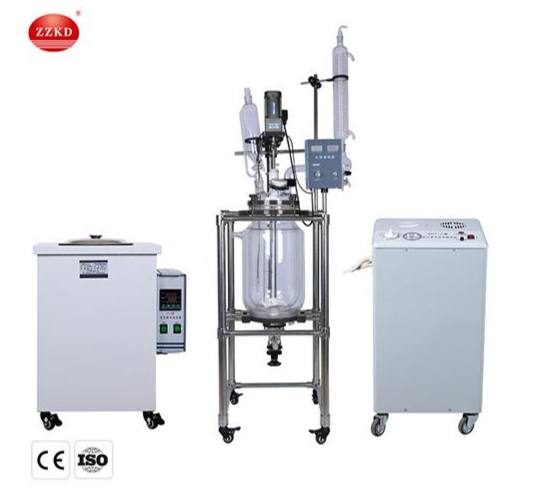


A glass reactor system refers to a complete setup or apparatus that includes not only the glass reactor vessel but also various ancillary components and accessories needed for conducting chemical reactions. Here are the key components typically found in a 5L glass reactor system:
Glass Reactor Vessel: The central component is the glass reactor vessel itself. It is made of high-quality borosilicate glass, which is resistant to thermal shock and chemical corrosion. The vessel is where the chemical reaction takes place, and it provides visibility for monitoring the reaction.
Stirring Mechanism: Most 5L glass reactor systems are equipped with a stirring mechanism to promote mixing and homogeneity of the reactants. The stirring mechanism can be a magnetic stirrer that uses a magnetic stir bar inside the reactor vessel or an overhead mechanical stirrer that agitates the contents.
Temperature Control System: Glass reactors often have a temperature control system to regulate the temperature during the reaction. This system typically consists of an external temperature control device, such as a heating mantle or a heating bath, for heating, or a chiller or refrigerated circulator for cooling. The temperature control system is connected to the double jacket or external cooling/heating coils of the reactor vessel.
Condenser: A condenser is an essential component in a glass reactor system, especially for reactions that involve volatile substances or require refluxing. The condenser helps to condense and collect vapors generated during the reaction, preventing their loss. It typically consists of a glass tube or coil cooled by circulating coolant, such as water.
Vacuum System: Some glass reactor systems include a vacuum system for conducting reactions under reduced pressure. The vacuum system can consist of a vacuum pump and associated valves and connectors. It allows for removal of air or unwanted gases from the reactor vessel, facilitating specific types of reactions.
Sampling and Ports: Glass reactor systems often feature ports or openings for sampling, addition of reagents, or connecting instrumentation. These ports allow for convenient sampling during the reaction or introduction of additional substances at various stages.
Safety Features: Glass reactor systems incorporate safety features to protect operators and prevent accidents. These may include safety valves, pressure relief systems, or rupture discs to handle excessive pressure. Some systems may also have safety interlocks to ensure proper usage and prevent mishaps.
Control and Monitoring Instruments: Glass reactor systems may have instruments for monitoring and controlling various parameters, such as temperature, pressure, and stirring speed. These instruments can include temperature controllers, pressure gauges, flow meters, and digital displays for real-time monitoring.
Support Structures and Accessories: Glass reactor systems are often accompanied by support structures, such as stands or frames, to hold the reactor vessel and other components in place. Additionally, accessories such as clamps, connectors, and tubing are included to ensure secure connections and facilitate the smooth operation of the system.
Control and Automation: Advanced glass reactor systems may include control and automation features. These can range from basic manual controls to more sophisticated programmable logic controllers (PLCs) or computer-based control systems. Automation allows for precise control of various parameters, such as temperature, stirring speed, and dosing of reagents, enhancing process reproducibility and accuracy.
Gas Inlet and Outlet: Some glass reactor systems have provisions for gas inlet and outlet. These ports or connectors allow for the introduction of gases into the reactor vessel or removal of gases generated during the reaction. This feature is particularly useful for reactions that involve gas-phase reactions or require specific gas atmospheres.
pH Monitoring and Control: In certain applications, glass reactor systems may include pH monitoring and control capabilities. This involves the integration of pH sensors and controllers to monitor and adjust the pH level during the reaction. pH control is crucial for reactions that are pH-sensitive or require specific pH conditions for optimal performance.
Filtration and Solid Separation: Glass reactor systems can be equipped with filtration systems to facilitate solid-liquid separation during the reaction. These systems may include filter flasks, filter plates, or filter funnels to capture solid particles while allowing the liquid phase to pass through. Filtration capabilities are valuable for processes involving catalysts, crystallization, or solid product isolation.
Process Monitoring and Data Logging: Advanced glass reactor systems may have features for process monitoring and data logging. This can include the integration of sensors to measure various parameters such as temperature, pressure, pH, or dissolved oxygen. The data logging capability allows for the recording and analysis of process data for quality control, process optimization, or documentation purposes.
Customization Options: Glass reactor systems can often be customized to meet specific application requirements. Manufacturers may offer options such as different reactor vessel sizes, additional ports, specialized fittings, or compatibility with specific accessories or auxiliary equipment. Customization options enable users to tailor the glass reactor system to their specific needs and experimental setups.
It’s important to note that the specific components and features of a glass reactor system can vary depending on the manufacturer, intended application, and customization options. When selecting or using a glass reactor system, it’s essential to carefully review the specifications and instructions provided by the manufacturer to ensure safe and effective operation.


