





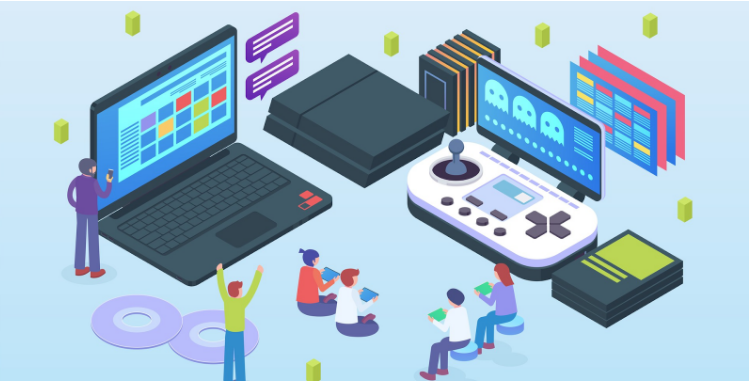


The gaming business has grown tremendously in recent years, and the need for high-quality game materials has expanded proportionately. A game asset is a piece of software designed expressly for use in a video game.
What Exactly Is a Game Asset?
A digital item generated expressly for use in a video game is known as a game asset. The goal of game assets is to enhance the entire visual and aural experience of the game by include anything from people, weapons, and vehicles to buildings, trees, and other environmental aspects.
The quality and complexity of game assets will depend on the creator’s expertise and the needs of the game. Game assets may be created utilizing a variety of tools and applications. Producing game assets requires a range of skills, including 3D modeling, animation, texturing, and programming, and is often done by artists, designers, and programmers.
How To Create a Game Asset?
Concept development, game art production, modeling, texturing, and animation are all processes in the creation of a gaming component. The first stage in generating a game asset is to come up with an idea that matches with the game’s overall vision. This idea will drive the design process and guarantee that the asset fits in with the game environment flawlessly.
After an idea has been conceived, a 3D model of the asset is created using specialist tools such as Autodesk Maya or Blender. The 3D model is built by molding polygons, which are digital clay-like materials, into the desired shape. This is a time-consuming technique that requires a high level of expertise and attention to detail.
After the model is finished, the following step is to texture it. Colors, patterns, and other elements are added to the model to make it seem more lifelike. Texturing is often accomplished using specialist applications such as Substance Painter or Photoshop.
Lastly, if required, the item is animated using tools such as Autodesk MotionBuilder or Unity. The process of producing a sequence of motions or actions that the object may execute inside the game, such as running, leaping, or firing, is known as animation.
What Kinds of Game Assets Exist?
There are several sorts of game assets, each having its own function in the game environment. The following are some of the most frequent categories of gaming assets:
- Characters. Characters are one of the most significant gaming components since they are often the game’s focal point. Characters may be heroes, villains, or other NPCs from the game universe. Characters may be humanoid or non-humanoid, with designs ranging from realistic to stylised.
- Environments. The sceneries and backdrops that comprise the gaming world are referred to as environments. Forests and mountains, as well as cities and space stations, are examples of environments. Environments are often constructed by combining 3D modeling, texturing, and lighting methods.
- Weapons. Characters in the game world use weapons to combat and protect themselves. Guns, swords, bows, and other sorts of equipment are examples of weapons. 3D modeling and texturing methods are often used to manufacture weapons.
- Props. Props are little things that fill the game world and offer depth to surroundings. Props might range from chairs and tables to rocks and trees. Props are often built by combining 3D modeling and texturing methods.
What Software Is Required to Make a Game Asset?


To generate game assets, you’ll need a suite of software tools dedicated to 3D modeling, texturing, animation, and scripting. Following are some of the most often used software tools by game developers:
- Autodesk Maya. Autodesk Maya is a commonly used 3D modeling and animation program in the game industry. It enables artists to construct detailed character, environment, and object models and animations.
- Substance Painter. Substance Painter is a strong texturing program that enables artists to generate realistic textures for game elements. It has a number of features, including generative texturing, 3D painting, and real-time feedback.
- Unity. Unity is a game engine that offers a variety of tools and features for game production, such as physics simulations, lighting, and sound effects. Game developers use it extensively to construct both 2D and 3D games.
- C++. C++ is a computer language that is commonly utilized in the gaming industry to construct the logic and functionality of game elements. It is a strong and fast programming language that enables game creators to construct complex behaviors and interactions for game elements.
Conclusion
Developing game assets is an important component of game development and requires a variety of skills and tools. As the gaming business expands, so will the need for high-quality game assets, making game asset development an interesting and profitable sector for both artists and developers.


