





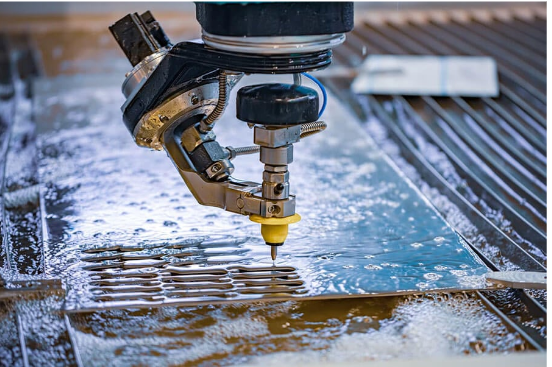


Imagine a tool that blends simplicity, precision, and power into one efficient package. This is not the stuff of science fiction; it’s the reality of waterjet cutting. A revolutionary technology that has been transforming the manufacturing sector, leading to enhanced productivity and efficiency on unprecedented scales.
What is Waterjet Cutting
Waterjet cutting (WJC) is an advanced machining process that employs high-pressure streams of water, or a mixture of water and an abrasive substance, to cut through materials. From metal and glass to stone and composites, waterjet cutting effortlessly performs tasks that other traditional tools find daunting. The technology owes its versatility to the immense power of water when pressurized and directed accurately.
The Role of Waterjet Cutting in Manufacturing

In the complex world of manufacturing, the journey from raw material to a finished product is laden with numerous processes. Waterjet cutting is the silent yet powerful ally that ensures this journey is smooth, swift, and cost-effective.
To appreciate how waterjet cutting enhances productivity in manufacturing, let’s delve into its unique advantages.
Precision Cutting
With waterjet cutting, the notion of “cutting corners” is rendered obsolete. This technology guarantees accuracy to the level of 0.005 inches, thereby reducing the need for secondary finishing processes.
It ensures uniformity in replicated designs, thereby enhancing product consistency.
It eliminates the possibility of material distortion caused by heat-based cutting methods.
It allows for intricate and complex designs to be cut accurately, opening up a world of possibilities for innovative products.
Material Versatility
A defining attribute of waterjet cutting is its ability to work with an array of materials without discrimination. It can seamlessly cut through materials that range from glass and metal to rubber and foam.
No material is too hard or too soft for a waterjet cutter.
Its versatility reduces the need for multiple cutting tools, thereby minimizing tool changeover times.
It allows manufacturers to broaden their product range without the need for significant tooling investments.
Environmentally Friendly
In the era of sustainable manufacturing, the environmental impact of any process is a critical consideration. Waterjet cutting earns high marks in this regard.
- There are no hazardous waste products generated, and the water used can be recycled.
- It eliminates the need for heat or harmful chemicals, reducing the carbon footprint.
- It promotes material utilization by allowing nesting of parts, leading to lesser waste.
Research and Studies Supporting Waterjet Cutting
Several studies validate the role of waterjet cutting in enhancing manufacturing productivity. For instance, a research paper published in the Journal of Manufacturing Science and Engineering [URL to the study] reported significant productivity gains with waterjet cutting, particularly in sectors dealing with composite materials.
Another study in the International Journal of Advanced Manufacturing Technology [URL to the study] emphasized the precision and material versatility of waterjet cutting, citing these as critical factors contributing to increased manufacturing efficiency.
The Cost-Effectiveness of Waterjet Cutting
In the world of manufacturing, productivity and cost-effectiveness go hand in hand. In this scenario, waterjet cutting presents a compelling case for its deployment in any manufacturing operation.
Lower Operational Costs
Operating a waterjet cutter is generally less expensive than other cutting technologies. It requires less energy to operate, translating to lower utility bills. Additionally, it doesn’t need expensive gases or coolants, as is the case with other cutting methods.
The maintenance costs are significantly reduced because of the absence of heat-related wear and tear.
The need for secondary processes like deburring and finishing is minimized, which reduces labor costs.
Water jet cutting enables manufacturers to significantly lower their production costs, leading to increased profit margins.
Less Waste Generation
Waterjet cutting exhibits an impressive material utilization rate. It cuts very close to the parts, reducing the material wasted in the cutting process. Also, it allows for tight nesting of parts, further minimizing material waste.
It significantly reduces the amount of scrap material generated.
The lower waste generation can result in significant cost savings on raw materials over time.
By reducing waste, waterjet cutting not only cuts costs but also contributes to sustainability goals.
Reduced Downtime
Another area where waterjet cutting shines is the reduction of machine downtime. The lack of heat generation eliminates the cooling time required in thermal processes.
There is no need for tool changes for different materials, reducing setup times.
The reduction in machine downtime translates into faster turnaround times and higher production rates.
This aspect adds to the cost-effectiveness of the waterjet cutting process, reinforcing its value in manufacturing.
The Impact of Waterjet Cutting on Workforce
Waterjet cutting not only impacts the manufacturing process but also has a significant effect on the workforce.
Safety and Health Benefits
Waterjet cutting is a cold process, which means there are no heat-affected zones or risks of burns. Additionally, it doesn’t produce harmful fumes or dust that can impact workers’ health.
The working conditions are safer compared to other cutting methods, contributing to a healthier work environment.
A safer workplace can lead to fewer health-related absences, boosting productivity.
By offering a safer work environment, manufacturers can attract and retain a skilled workforce.
Easier Training and Operation
The operation of waterjet cutters is less complex compared to some other cutting methods. Training employees on the use of these machines is relatively straightforward.
Workers can quickly learn to operate the machines, reducing training time and costs.
The ease of operation also allows for increased flexibility in task assignments.
A skilled workforce leads to more efficient operations and higher productivity.
Conclusion
The transformative power of waterjet cutting in manufacturing is comprehensive, touching upon every facet of the process. Its advantages extend beyond the manufacturing floor, positively impacting operational costs, waste generation, and the workforce. By adopting waterjet cutting, manufacturers can experience enhanced productivity and enjoy the benefits of a cost-effective and sustainable method. The manufacturing industry is continually evolving, and it’s clear that waterjet cutting is poised to be a significant driver of this evolution.


