

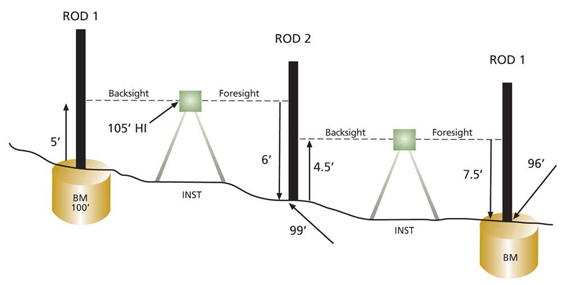

Introduction: Benchmark surveying is a crucial aspect of land surveying that involves establishing precise reference points, known as benchmarks, to ensure accurate measurements and mapping. It is vital in various fields, including construction, engineering, urban planning, and cartography. This article will explore the science behind benchmark surveying, its significance, methods, and critical considerations.
The Significance of Benchmark Surveying
Benchmark surveying is the foundation for reliable and consistent measurement and mapping practices. By establishing benchmarks, surveyors create a standard reference system that allows for accurate comparison and analysis of data collected over time. These benchmarks act as fixed points of reference, enabling the measurement of changes in elevation, the determination of land boundaries, and the creation of precise topographic maps.
Accurate elevation data is crucial for a wide range of applications. It aids in designing and constructing infrastructure projects such as roads, bridges, and buildings, ensuring they are level and properly aligned. It also assists in floodplain mapping, assessing terrain suitability for agriculture, and analyzing environmental impacts.
Methods of Benchmark Surveying
Differential Leveling:
Differential levelling is one of the most commonly used methods in benchmark surveying. It involves measuring vertical distances between benchmarks using a level instrument, such as an automatic or digital level. By comparing the elevations of various models, surveyors can determine the differences in height and establish accurate contours.
Global Navigation Satellite Systems (GNSS):
GNSS, such as the Global Positioning System (GPS), has revolutionized surveying. By using satellites to determine precise positions on Earth, surveyors can establish benchmarks with high accuracy. GNSS technology allows for rapid data collection over large areas, making it particularly useful for mapping and surveying projects that require extensive coverage.
Trigonometric Leveling:
Trigonometric levelling involves using trigonometry and angular measurements to calculate elevations. This method relies on the principle of similar triangles and requires using theodolites or total stations to measure angles. Surveyors can calculate the elevation differences by establishing a baseline and measuring the angles between the baseline and the benchmarks.
Critical Considerations in Benchmark Surveying
Datum Selection:
When establishing benchmarks, selecting an appropriate datum that serves as the reference point for all measurements is crucial. The North American Vertical Datum (NAVD88) and the Universal Transverse Mercator (UTM) coordinate system are commonly used. The choice of datum depends on the specific requirements of the project and the regional coordinate system in use.
Benchmark Stability:
The stability of benchmarks is vital to ensure the accuracy and reliability of surveying data over time. Standards should be established on stable and permanent features, such as bedrock or concrete monuments, to minimize the risk of subsidence or movement. Regular monitoring of benchmarks is essential to detect any changes and maintain the integrity of the reference points.
Error Analysis:
Surveying inherently involves measurement errors, which can affect the accuracy of the collected data. Surveyors must conduct thorough error analysis and apply appropriate correction techniques to minimize mistakes. Environmental conditions, instrument calibration, and human error should be considered and accounted for during data processing.
Advancements in Benchmark Surveying
Remote Sensing: Integrating remote sensing technologies such as aerial LiDAR (Light Detection and Ranging) and aerial photogrammetry, has dramatically enhanced benchmark surveying capabilities. LiDAR allows for rapidly collecting highly accurate elevation data by emitting laser pulses and measuring their return time. Aerial photogrammetry utilizes aerial imagery to generate three-dimensional models, aiding in identifying and establishing benchmarks.
Mobile Mapping Systems:
Mobile mapping systems with various sensors and navigation technologies offer a dynamic approach to benchmark surveying. These systems can be mounted on vehicles or carried by surveyors, capturing data in motion. By combining GNSS, inertial measurement units, and laser scanning, mobile mapping systems provide a comprehensive solution for capturing benchmark information efficiently and accurately.
Conclusion:
Benchmark surveying is an essential science that underpins accurate measurements, mapping, and analysis in various fields. By establishing benchmarks, surveyors create a consistent reference system that enables the precise determination of elevation changes, land boundaries, and topographic features. The methods used in benchmark surveying, such as differential levelling, GNSS, and trigonometric levelling, offer different approaches to achieving accurate measurements. Key considerations, including datum selection, benchmark stability, and error analysis, ensure the reliability of surveying data. Advancements in technologies, such as remote sensing and mobile mapping systems, have further enhanced the capabilities of benchmark surveying. As technology evolves, benchmark surveying will be crucial in shaping our understanding of the Earth’s surface and facilitating various development projects.
