







Ethiopia, a landlocked nation, is the second most populous and oldest independent state in Africa. The country is renowned for its distinctive cultural heritage. The expansion of European powers throughout the course of the 19th and 20th centuries shaped modern Ethiopia. It should come as no surprise that Ethiopia has a wealth of amazing historic places to explore being one of the oldest nations in the globe.
Other than its intriguing history, Ethiopia is known for its diverse landscape and alluring scenery. Travel to Ethiopia to learn more about the country and its people, places, culture, and history. For the best flight deals, you have to book your seat with Ethiopian Airlines at least four to five weeks in advance.
Some of the leading flight routes offered by the airline are Dubai to Addis Ababa, Dubai to Accra, Dubai to Cape Town, Dubai to Doula, etc. You can choose a round-trip, one-way, or stopover flight based on your needs.
Some of the Ethiopian cultural landmarks to explore are:
1. Axum
The ancient city, Axum is one of Ethiopia’s most culturally remarkable places. Nevertheless, exploring this city located in the northern part of Ethiopia is to deal with the legends and facts. Axum, which was the former capital of the country, is a sizable city with a population of over 50,000.
The Stelae field at Axum, where enormous obelisks tower over 24 metres into the air, is what the city is best known for. UNESCO designated these amazing buildings as a World Heritage Site in 1980, for their remarkable past, dating back to 400 BCE.
Axum is the oldest city in northern Africa and is known as the residence of the Queen of Sheba and the Ark of the Covenant (according to legend). Hence, it was continuously inhabited. A short and quick tour of the northern part of Axum takes you to the Stelae field of numerous monuments known as the Obelisks of Axum, which were carved and built in the 4th century.
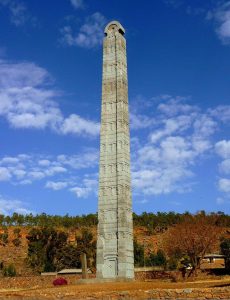

Image Resource: en.wikipedia.org
The imposing pillars are over 24 metres tall, 1700 years old, and 160 tonnes in weight and are built of solid granite. Since the 1970s, archaeologists have discovered other tombs in the same area in Axum, but unhappily, most of them had been looted by tomb raiders, and only one of them, The Tomb of the False Door, is currently accessible to tourists. The Church of Saint Mary of Zion, which is about 1,700 years old, is worth visiting.
You can find obelisks, magnificent churches, unknown tombs, castle ruins, and other cultural treasures from various eras and religions in abundance in Axum. From Mekele, it takes roughly 3 hours and 45 minutes to reach Axum by car.
2. Lalibela
Lalibela is renowned for the rock-hewn churches, which are divided into two major clusters, with the majestic Bet Giyorgis standing splendidly some 300 metres away from the other buildings. The rock-hewn churches are located on a nearly triangular 15-acre site on each side of a rock-cut creek, which is called the Jordan River by the local people.
You can find several churches and chapels in the northern group, which appear to be much more cohesive and organised. Some contend that this supports the theory that it was possibly built by King Lalibela using a convincing plan.
Seven churches make up the southern cluster, and it is located 250 metres away from the northern cluster, with no symmetry and order little obvious. The handholds and steps look smooth and wide owing to their frequent use.
The northern cluster consists of churches of three-quarter or subterranean monoliths. The rocks around are used to have walls on three sides, before grounding away the interiors, giving a stunning effect. The remaining churches were built inside pre-existing rock caverns, fissures, and faces, showing greater antiquity.
3. Gonder
The decaying castle ruins, now the UNESCO World Heritage Site, that previously served as the residence of the monarchs, emperors, and queens of this country serve as evidence that Gonder was Ethiopia’s third capital city. The city, which is renowned for its interior decor and architecture and several mediaeval castles, was founded in 1635 by Emperor Fasiledes.
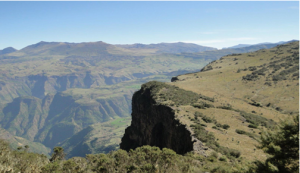

Image Resource: commons.wikimedia.org
Gonder was once a famous and thriving centre for art and religious learning. Being an entrance to the Simien Mountains National Park, the city is one of the tourist attractions during the annual Timkat festival in January.
4. Harar
The mediaeval city of Harar, which is viewed as one of the holiest cities in Islam, houses numerous shrines and mosques, which are said to characterize as many as 99 names of Allah known to humankind. The Arab Muslim cleric Sheikh Abadir Umar ar-Rida, who serves as the city of Harar’s patron, is thought to be responsible for this historic city’s Islamic population.
It was in 1216 when the Sheikh from the Arabian Peninsula arrived in Harar, had a Harari wife, and built the Jamia mosque. It is simple to get lost in Harrah’s endless maze of winding alleyways, which are known for its Hyena men, range of markets, antiquities, and ancient paintings, spanning all cultures.
5. Addis Ababa
Being one of the highest capital cities at an altitude of 2,665 metres, Addis Ababa is known for its people not hiding rather than showing their emotions since it was founded in 1892 by Ethiopian Emperor Menelik. The has a rich history and attractions to merit more than just a stay.
You can visit several museums in Addis Ababa. Among the best is the National Museum of Ethiopia, which houses the well-known skeleton of the oldest hominid ancestor, Australopithecus.
With regular flights to Addis Ababa, Ethiopian Airlines helps you plan a trip to Ethiopia to discover its historical sites and other attractions.


